
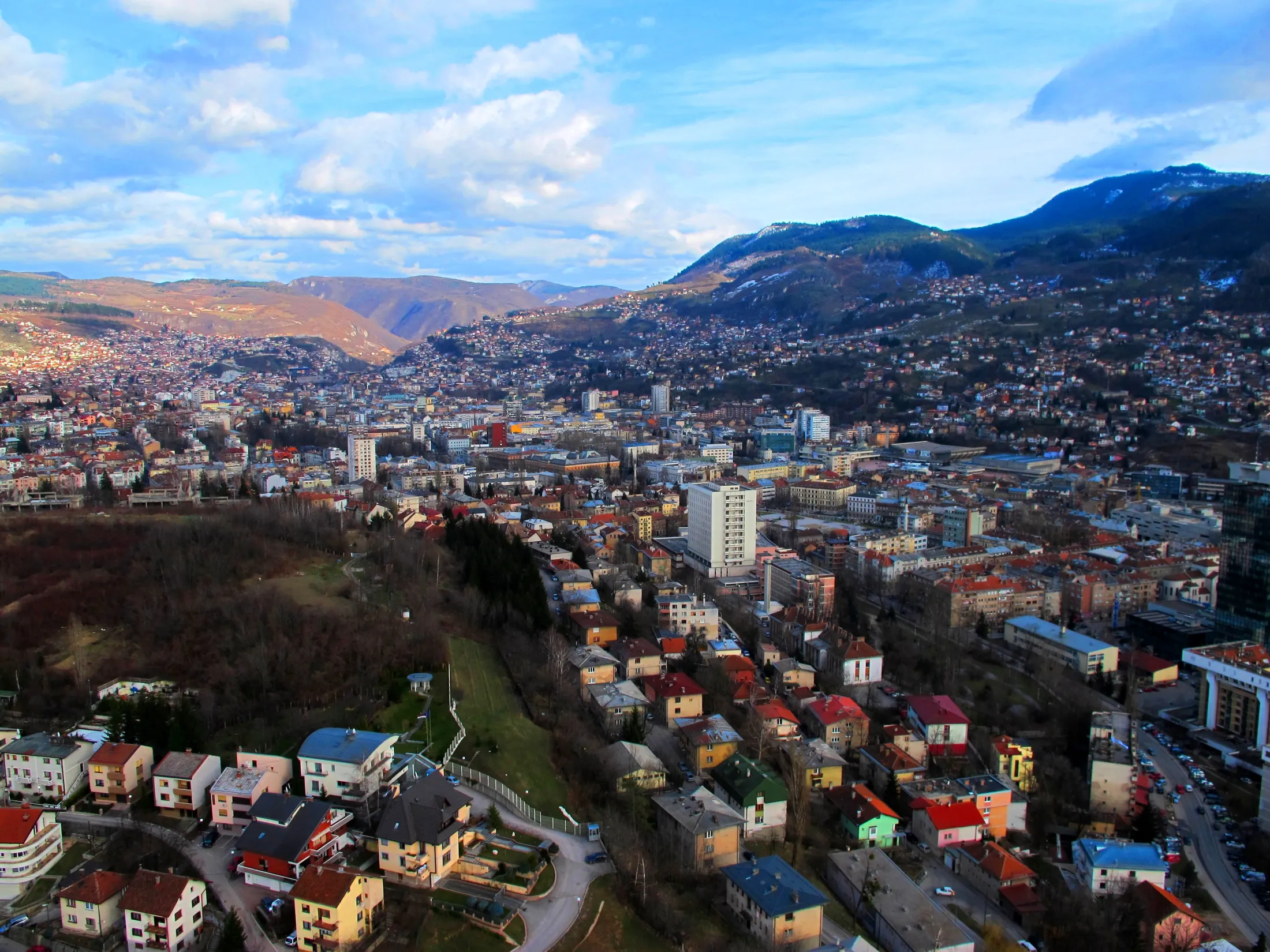
In 1984, Sarajevo hosted the Winter Olympics. Eight years later, that same city endured 1,425 consecutive days of siege — the longest siege of a capital city in the history of modern warfare. No other city in Europe carries that kind of compressed historical weight within walking distance of a working bakery and a plate of ćevapi that costs €4.
Most travelers hit Sarajevo as a footnote — a rushed day trip from Dubrovnik or a layover en route somewhere else. That’s a miscalculation. Sarajevo deserves at minimum four days, and it costs less than a long weekend in Lisbon to do it properly.
A City Built at the Collision of Four Civilizations
Sarajevo sits in a steep valley carved by the Miljacka River, ringed by hills that still carry the ghosts of 1990s sniper positions. That geography forced the city to grow dense and close. The compression turns out to be a feature: you can walk from the Ottoman bazaar to the Austro-Hungarian cathedral district to socialist-era apartment blocks in under 20 minutes.
No other European capital gives you that kind of civilizational layering on foot. Vienna has grandeur. Dubrovnik has the walls. Istanbul has the mosques. Sarajevo has all three architectural traditions plus a 20th-century war museum, stacked together like geological strata.
The Compact City That Crosses Centuries in One Walk
The old town — Baščaršija — is the Ottoman core, built in the 15th century under Isa-Beg Isaković. It’s a working bazaar, not a preserved museum piece. Coppersmith workshops called kazandžije still operate on Kazandžiluk Street. The Gazi Husrev-beg Mosque, constructed in 1531, holds Friday prayers attended by locals, not tour groups. Entry is free. Remove your shoes.
Walk west down Ferhadija Street and the Ottoman archways give way to coffee houses with wrought-iron chairs and neoclassical facades — Habsburg-era construction from the late 19th century. The transition happens mid-block. There’s a brass plaque embedded in the pavement marking the exact spot where East meets West. It sounds like a tourist gimmick. It isn’t.
The Sebilj fountain — Ottoman style, built 1891, rebuilt 1913 — anchors the bazaar square. Pigeons. Locals arguing about coffee. Teenagers eating burek on the steps. It’s exactly what a city center should look and sound like.
Four Religions in One Square Kilometer
Within roughly one square kilometer of the old town: the Gazi Husrev-beg Mosque (Muslim, active since 1531), the Sacred Heart Cathedral (Catholic, completed 1889), the Serbian Orthodox Cathedral (built 1872), and the Old Temple Synagogue (Sephardic Jewish, dating to 1581 — one of the oldest in the Balkans, now a museum). On Friday at noon, you’ll hear the call to prayer. On Sunday morning, cathedral bells from two denominations.
The coexistence isn’t a tourism brochure claim. It’s lived urban reality that was severely damaged in the 1990s war and is still, visibly, being rebuilt — socially and literally. That tension between what this city was, what happened to it, and what it’s becoming is what makes Sarajevo feel unlike anywhere else on the continent. Prague is beautiful. Sarajevo is honest.
What It Actually Costs to Visit Sarajevo
Bosnia and Herzegovina uses the Convertible Mark (BAM), pegged to the euro at 1.96 BAM = €1. Prices below are in euros for easy comparison.
| Expense | Sarajevo | Prague | Lisbon | Amsterdam |
|---|---|---|---|---|
| Midrange hotel (per night) | €45–€75 | €80–€130 | €90–€150 | €140–€200 |
| Sit-down dinner (2 courses) | €8–€14 | €18–€28 | €20–€35 | €30–€50 |
| Local coffee | €0.80–€1.50 | €2–€3 | €1–€2 | €3–€4 |
| Museum or attraction entry | €2–€6 | €6–€15 | €5–€12 | €15–€25 |
| Airport taxi to city center | €10–€15 | €25–€35 | €15–€20 | €45–€55 |
| 24-hour tram pass | €1.80 | €5 | €6.40 | €9 |
A realistic daily budget: €50–€80 per person covering a midrange hotel, two meals out, one attraction, and local transport. Travelers staying in guesthouses and eating ćevapi twice a day can get below €40 without trying.
Bottom Line: Sarajevo runs 40–60% cheaper than Prague or Lisbon for a comparable quality of experience. If the cost of European travel is what’s slowing your planning, this city directly addresses that constraint.
How to Structure Four Days in Sarajevo
Sarajevo rewards slow movement. Four days is enough to feel the city rather than just photograph it. Here’s a sequence that actually works:
- Day 1 — The Old Town, Unrushed. Arrive, orient in Baščaršija, walk the coppersmith’s alley (Kazandžiluk), visit the Gazi Husrev-beg Mosque (free), have Bosnian coffee at Džirlo on Kovači Street. Evening: the Sebilj fountain area at dusk. Walk the full length of Ferhadija Street west into the Austro-Hungarian quarter. Eat dinner somewhere with a charcoal grill visible from the door.
- Day 2 — History You Cannot Look Away From. Morning at the War Childhood Museum on Logavina Street (€4 entry, allow 1.5–2 hours; it’s built entirely from objects donated by Sarajevo survivors and is genuinely affecting). Afternoon: the Latin Bridge, where Archduke Franz Ferdinand was assassinated on June 28, 1914 — the event that triggered WWI. The bridge is shorter than you expect. The plaque is easy to miss. That’s part of the point.
- Day 3 — Outside the Center. Morning at the Tunnel of Hope (Tunel Spasa) in Butmir — the 800-meter tunnel dug under the Sarajevo airport during the siege, the only supply line into the besieged city (taxi from center: ~€8, entry: €5). Afternoon: the Trebević cable car, rebuilt and reopened in 2018 (€4 round trip), to the 1984 Winter Olympics bobsled track. It’s now overgrown, graffitied, and completely surreal. Take it.
- Day 4 — Day Trip or Deeper Stay. Bus to Mostar takes 2.5 hours and costs around €10, with departures from the Sarajevo main bus station. Stari Most (the reconstructed 16th-century stone bridge, rebuilt in 2004 after being destroyed in the 1993 shelling) is worth the round trip. Alternatively, stay in Sarajevo and visit Vrelo Bosne — a wetland park 12km from the city, reachable by tram to Ilidža then a short horse-carriage or bicycle ride.
Buy a 24-hour tram pass (€1.80) only if you plan to travel beyond the walking center. Most of days 1 and 2 require no transport at all.
The Tunnel of Hope Is Not Optional
Skip the Tunnel of Hope and you’ve missed the point of the entire trip.
Between 1992 and 1995, the Bosnian government and civilian volunteers dug an 800-meter tunnel beneath the UN-controlled Sarajevo airport runway to move food, weapons, medicine, and people in and out of a city under constant bombardment and encirclement. Civilians crawled through it. Soldiers walked through it stooped at the waist. The city’s electricity grid was eventually threaded through it. The section open to visitors today covers about 25 meters — but the preserved house above it, the documentary footage, and the original equipment on display explain the other 775.
Entry: €5. Taxi from Baščaršija: €8 each way. Total visit time: 90 minutes. There is no version of a thoughtful trip to Sarajevo that justifies skipping this.
When Sarajevo Will Let You Down
Sarajevo is not a polished destination. That’s a significant part of its appeal — but it won’t work for every traveler, and overselling it does no one any favors.
The Seasonal Crowding and Heat Problem
July and August bring real crowds. Baščaršija gets packed. Hotel rates jump 30–40% above spring levels. The Tunnel of Hope queues extend outdoors in the midday sun. Temperatures regularly hit 35°C in a city built inside a valley, where heat accumulates and there’s no sea breeze to offset it. The Trebević cable car queues back up on weekends.
April through June and September through October are the right windows — temperatures between 18–26°C, shorter queues, better hotel rates (€35–€55/night for midrange options). November through March is cold and often grey, but atmospheric for street photography, and room rates drop significantly. If you go in winter, pack for it.
Getting Here Is Not Like Getting to Paris
Sarajevo International Airport (SJJ) has limited direct connections. Wizz Air serves it from London Luton, Vienna, and a handful of other European cities. Austrian Airlines connects via Vienna. There is no high-speed rail option — getting here from Western Europe means a flight or a lengthy overland journey through the Balkans. Budget an extra travel day each direction.
Inside the city: the tram covers the main east-west corridor well. Getting to the Tunnel of Hope or Vrelo Bosne requires taxis or ride-share apps — Bolt and inDriver both operate here. Cash-only establishments are common outside the tourist core; draw BAM from city-center ATMs rather than exchanging at the airport, where rates are noticeably worse.
Bosnian Food: What to Order and What to Ignore
Is Ćevapi at Ćevabdžinica Zeljo Worth the Queue?
Yes. Full stop.
Ćevapi — small grilled minced beef and lamb sausages served in a flatbread called somun with raw white onion and kajmak (a tangy, cream cheese-adjacent dairy spread) — is Sarajevo’s defining dish. Ćevabdžinica Zeljo on Kundurdžiluk Street has a line out the door most lunchtimes. A portion of 10 ćevapi costs €4–€5. The line moves fast. Eat standing at the counter or carry it to the Sebilj fountain. This is not restaurant dining. It’s how people in this city eat lunch.
If the queue at Zeljo is genuinely too long, Ćevabdžinica Hodžić near the Latin Bridge is a legitimate alternative with comparable quality and shorter waits. Any kafana in the old town with a charcoal grill visible and running is almost certainly a safe bet.
Should You Drink Bosnian Coffee or Just Skip It?
Bosnian coffee is not Turkish coffee, despite what some menus say. The preparation differs: unfiltered grounds are added to boiling water in a džezva (small copper pot) and poured while still cloudy into your cup. You let the grounds settle before drinking. It comes with a sugar cube — hold it between your teeth, don’t dissolve it in the cup — and a glass of water.
The ritual is the point. Ordering one at Džirlo on Kovači Street or at Pod Lipom near the Gazi Husrev-beg Mosque and sitting for 45 unrushed minutes costs about €1.20. That’s more authentically local than most ticketed tourist experiences in the city. Order it. Sit with it. Don’t check your phone for the first ten minutes.
What’s Worth Eating Beyond the Obvious Spots?
Burek — flaky phyllo pastry filled with minced meat — from a pekara (bakery) is the breakfast the city runs on. A slice costs €1–€2. Find a pekara where locals are already queuing; avoid anything marketed as “tourist burek” with a laminated photo menu. The Sač bakery near Baščaršija opens early and consistently delivers.
For a proper sit-down dinner, Inat Kuća (translated: “Spite House”) on the Miljacka riverbank is the best value among the old-town restaurants — Bosnian lamb stew and grilled meats in the €10–€15 range, in a building with a genuinely odd story behind its name. Ask your server. The food holds up and the river-facing terrace earns its reputation.
Bottom Line: How Sarajevo Compares to the Alternatives
Sarajevo won’t appeal to everyone. If your Europe trip is built around beach access, fast rail connections between capitals, or a Michelin-starred dinner, this isn’t the right detour. But if you want a city with genuine historical density, affordable daily costs, and the kind of street-level texture that more heavily touristed capitals have largely lost — Sarajevo delivers on all three.
- Sarajevo vs. Tbilisi: Both are underrated, affordable cities with layered histories. Tbilisi has better wine and Caucasus hiking access. Sarajevo has more concentrated walkable history and easier European flight connections. Call it a tie depending on your starting point.
- Sarajevo vs. Skopje: Skopje is flashier — the result of a 2010s government beautification project that remains controversial. Sarajevo is more historically significant and more rewarding to explore on foot. Not a close comparison.
- Sarajevo vs. Mostar: Mostar is a half-day or full-day trip from Sarajevo, not a replacement for it. Do both. The bus between them costs €10 and takes 2.5 hours.
- Sarajevo vs. Belgrade: Belgrade has better nightlife and more restaurant diversity. Sarajevo has more specific historical focus and a tighter, more walkable core. The Sarajevo–Belgrade combination (5–6 hours by bus) is one of the stronger two-city itineraries in the Balkans if you have a week.
- Budget verdict: At €50–€80 per person per day all-in, Sarajevo offers more historical return per euro than any Western European capital. The only comparable value in Europe right now is Tbilisi, which is harder to reach from most departure cities. For travelers coming from the UK, Germany, Austria, or the Netherlands, Sarajevo is the stronger pick.